Showing posts with label CanadaMark. Show all posts

Tips for Buying Diamonds Online

With all of the potential for scams concerning diamonds, buying diamonds online almost seems unthinkable! However, you actually can purchase diamonds online, without any problems – as long as you are careful.

Why Buy Online
First, think about your reasons for wanting to purchase the diamond online, as opposed to making a purchase from a local jewellery store. The most common reason is price. Due to low overhead costs, online jewellers and wholesalers are able to offer lower prices. However, you must be careful – sometimes a price that is too low is a sure indication of a scam.

One of the best things about purchasing online is the unlimited selection. When shopping offline, you are limited to the selection in the stores in your general area. Online, there are no limits. But again, you must use a great deal of care and consideration before handing your money over to someone that you cannot see and have never met!

Research First
Before shopping, learn as much as you can about diamonds – especially cut, color, clarity and carat weights. When you are knowledgeable about diamonds, it will be harder for a con artist to rip you off. Once you know more about diamonds, you will be ready to start shopping.

Take your time. Don’t purchase the first diamond that you see that interests you. Instead, look for similar diamonds for sale. Do some comparison shopping to find the lowest prices. Once you have found the lowest price, start doing your investigation. You know about diamonds, you’ve found a diamond that you love, and you’ve found the lowest price – but you are still quite a ways away from actually purchasing that diamond!

Ask about the seller’s credentials, such as professional jewellery associations that they belong to. View and print the seller’s return, refund, and upgrade policies. Also inquire about additional services, such as settings and mountings, sizing, and free shipping. Do a search for customer reviews on this particular company around the Internet. Also check online to see if there have been any complaints. Ask for a diamond grading report from an independent laboratory such as GIA, HRD, EGL or AGS. You should see this before making a purchase.

Escrow Services
Finally, use a reputable escrow service for high dollar diamonds – preferably one that will have the diamond appraised while it is in their possession. The seller sends the diamond to the escrow service, and you send the money to pay for the diamond to the escrow service. The escrow service has the diamond appraised, sends the diamond to you, and sends the money to the seller. This is the surest way to protect yourself…again, make sure that you use a reputable escrow service!

About Diamond Grading Reports And Certificates

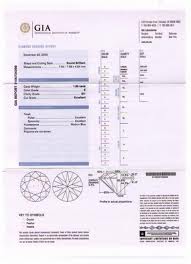
A diamond certificate is also known as a Diamond Grading Report. This report comes from the Gemological Institute of America (GIA), and you should require this report when you are purchasing a diamond.


 With a diamond certificate, you can verify the color, cut, carat weight, and clarity of the diamond. You don’t have to worry about a diamond dealer telling you anything less than the truth, because the certificate comes from the GIA – not the dealer. You may be required to pay for the certificate, but the cost is usually low, and in many cases, it will help you negotiate a better price on the diamond – or keep you from purchasing a lower quality diamond altogether.

If you buy a high quality diamond, and then later decide to sell the diamond, you will need to have the certificate, or you will have a hard time selling it to someone else. Furthermore, you can use the Diamond Grading Report to look up the wholesale value of the diamond in question. Use the guide that is used by the diamond cutting industry.

With the Certificate, or Diamond Grading Report, there won’t be any doubts when you are trying to purchase a diamond. You can easily find out what the diamond is worth. This will prevent you from overpaying, and it can prevent a seller from under-charging as well.

A copy of the Diamond Grading Report should be given to your insurance company as well, when you insure the diamond. This provides absolute, unquestionable proof of the value of the diamond should it be stolen in the future. Insurance companies cannot argue with the report.

Avoid diamond dealers who seem reluctant to provide a certificate! Also avoid sellers who tell you that a certificate diamond will cost you more – the only additional cost should be the cost of the certificate, which is low. If the dealer doesn’t want to provide a certificate, then you don’t want to do business with that dealer.

Don’t accept certificates from gemological laboratories other than GIA. There are many fly-by-night gemological labs these days, but in the end, GIA has been established as the most respectable and trustworthy – not to mention oldest – of the lot. So avoid dealers who don’t want to use GIA for certification purposes as well.

Don’t buy an expensive diamond without paying the extra cost of the certificate. If a dealer tries to convince you to make the purchase without the certificate, or if they want to use a company other than GIA, you can be sure that the dealer has probably greatly inflated the price of the diamond – they have something that they are hiding from you.

How To Determine Diamond Prices

Pricing most products is quite easy. Determine how much it costs to make the item, how much it costs to market that item, and then mark it up by 15 – 30% or more. Simple, right? Well, pricing diamonds isn’t quite that simple. There are many factors that are considered when diamonds are priced.

Diamond prices are determined first by adding the cost of the rough diamond, the cost of cutting the diamond, and all other costs necessary to turn the rough diamond into a marketable diamond. Depending on the importance of the diamond, an independent company may be called in to certify the grade of the diamond based on colour, cut, clarity, and weight.

Before reaching the retailer, the diamond must travel from the mine, to the cutter and polisher, to the independent grading company, and then to the primary market. Once it has reached the primary market, it will be purchased by diamond dealers and wholesalers, and from there it will be sold to retailers. The diamond becomes more expensive each time it changes hands, until it finally reaches a retailer, where the price is raised a bit more.

The value of a diamond is based on what the diamond will sell for in the market place through a retailer. As you can see, the earlier you can purchase a diamond in the process, the lower the cost of the diamond will be – but not the value.

If you own a diamond, and you have no idea how much it is worth, you can have it appraised, but the appraisal may not be accurate. You will be better off obtaining a certificate through GIA – Gemological Institute of America. With the information on this certificate, you can use a diamond price guide to accurately determine what your diamond is worth.

There are also many diamond price calculators available on the Internet, and many diamond dealers use these as well. You will realize that before you can accurately price a diamond, without a Diamond Grade Report, you need to know quite a bit about diamonds, such as different cuts, clarity, color, and weight – and how each of those aspects adds to the value of a diamond, or decreases the value of the diamond as the case may be.

Again, you will be better off if you get a Diamond Grading Report on the diamond, and use that information to look up the price in one of the guides that the diamond cutting industry uses. This will give you the most accurate value of the diamond in your possession, or of the diamond you are considering to purchase.

How To Sell Diamonds

There are many reasons why you may want to sell a diamond that you own. Perhaps you’ve gotten divorced, or you are strapped for cash. The reasons why don’t really matter – getting the best possible price is what counts! The way to obtain the best price for the diamond is to not be in a rush. Slow down, and carefully consider all of your options – there are many.

First, have the diamond appraised. In fact, have it appraised by two or three jewellers to get an accurate idea of the diamonds value. Tell the appraiser that you want the Rapaport Value. This is the wholesale value of the diamond, and it basically tells you the highest price that you can sell your diamond for. If your diamond has no certificate, you should consider getting a certificate from GIA. This may help you get a better price for the diamond as well.

First, try to sell the diamond yourself, to people you know. Friends and family members may be interested. If you don’t have any luck with friends or family members, you should turn to outside sources. Absolutely avoid pawn shops! A pawn shop will only offer you about 10% of what the diamond is worth! Also avoid offers of selling the ring on consignment. There are many things that can go wrong, and there is no shortage of diamond scams – even in well known jewellery stores.

If the diamond is important, you should strongly consider auctioning it off through one of the famous auction houses, such as Christie’s or Sotheby’s. If it isn’t what is considered an ‘important’ diamond or a high-end diamond, you should try to sell it to an individual using classified ads, or even eBay. However, selling to an individual that you do not know could put you in danger – especially if the diamond is worth a lot of money.

Your final option should be a jewellery store. It is vital that you not let your diamond out of your sight while in the jewellery store – you might find that the diamond you walked in with is not the same diamond that you walk out with! The jeweller will try to tell you that your diamond is of poor quality or low weight. Inevitably, there will be some problem with the diamond. This is where your appraisal and/or certificate will come in handy.

If the jeweller is fair, they will offer you between 60% and 80% of the value of the Rapaport Value. Do not accept anything less than this. Again, do not let the diamond out of your sight until you have been paid for it.

Quick Guide to Selecting Diamonds

Diamonds are graded for certification by laboratories using grading criteria. Four of these criteria are critical to understand when making a diamond purchase or investment. Known as the “Four C’s”, these criteria are: color, cut, clarity and carat.

Colour
Color is the result of the composition of a diamond and it does not change. When a jeweler is describing the color of a diamond they are referring to the presence or absence of color in white diamonds. Because a diamond with no color allows maximum light to pass through, colorless diamonds are preferred for their sparkle.

Read more on Diamond Colour.

Cut
Cut refers to a diamonds reflective quality. Most diamonds are cut with 58 facets. The brilliance of diamonds is heavily dependent on the cut. The different angles and the finish of a diamond determine its ability to reflect light and cause its brilliance and fire.

Remember that the cut of a diamond can have an impact on its durability as well as its beauty. Some cutting faults can make a diamond prone to breakage. A diamond that is cut too thin can also cause light to leak out of the back and the diamond will lose some of the sparkle and appear not to shine. So, as you can see the cut is probably the most important of the Four C’s.

Read more on Diamond Cut.

Clarity
During the formation process, inner flaws, or inclusions occur in most diamonds. The number and size of these inclusions determine what is referred to as the clarity of a diamond. Diamonds that are clear create more brilliance and therefore are rarer and highly priced. To be considered “flawless”, a diamond must have no surface or internal imperfections visible upon being viewed by a skilled diamond grader using 10 power magnifications.

Read more on Diamond Clarity.

Carat
Carat is the unit of weight by which diamonds are measured. One carat is equal to 200 milligrams. A carat is divided into 100 segments called points.

Read more on the carat weight.

When you go to the store to make that all important diamond purchase, do not be shy! Ask questions, get the answers needed to make an informed purchase. Shopping for certified diamonds enables you to make an informed selection. Knowing the “four C’s” allows you to comparison shop and purchase the best diamond at a fair price. But, before making a purchase, shop around and decide what shapes and styles really appeal to you. Enjoy your diamond for years to come!

Diamond Mines Around the World


Argye mine located in the Kimberley region in the far north east of Western Australia. Owned by Rio Tinto, this mine is the world’s largest single producer of volume of diamonds. However, due to low proportion of quality diamonds it is not the value leader. It does produce 90-95% of the world’s supply of pink diamonds.

Diavik is also owned by Rio Tinto, located in Canada, it is a very large mine. It is located north of Yellowknife and south of the Artic Circle on an island. The island is connected by an ice road. It is also an important part of the regions economy employing more than 700 people and producing more than 8 million carats annually.

Ekati diamond mine is owned by BHP Billiton and located south of the Artic Circle in the Northwest Territories of Canada. The Ekati is Canada’s first operational diamond mine. Diamonds mined here are sold under the Aurias trade name. Authenticity is verified through CanadaMark service. CanadaMark service is also owned by BHP Billiton Diamonds, Inc.

Baken diamond mine is located along the lower Orange River in South Africa. It is owned and operated by Trans Hex. The average size stone for 2004 was 1.29 carats. In 2004, this mine produced a 78.9 carat D color flawless diamond that sold for more than 1.8 million US dollars, as well as a 27.67 pink diamond that was sold for over 1 million US dollars.

Merlin is the second of only two diamond mines in Australia. It was once owned by Rio Tinto and sold to Striker Resources, and subsequently became North Australian Diamonds.

Orapa is the world’s largest diamond mine. It us located 240 Km west of Francistown. The mine is owned by Debswana, which is a partnership between De Beers and the government of Botswana. This mine operates 7 days a week. It maintains pre-primary and primary schools for its employee’s children. There is also a 100 bed hospital and game park. This mine began production in 1971 and is the oldest mine owned by the Debswana Company.

The Premier mine located in Cullinan, South Africa produced the largest diamond, the Cullinan Diamond, ever in 1905. The rough Cullinan Diamond weighed 3,106.75 carats (no. 17 in photo). The famous Hope Diamond, 44 carats, (no. 11) is small compared to the Cullinan Diamond.
This mine also produced the Golden Jubilee diamond which weighed 545.67 carats. This mine is formally owned by the De Beers Company and was renamed The Cullinan Diamond Mine in 2003 in celebration of its centennial. It was sold to Petra Diamonds in November 2007.

Recently, in September 2009, yet another giant 507 carat white diamond was discovered in the Cullinan mine.